
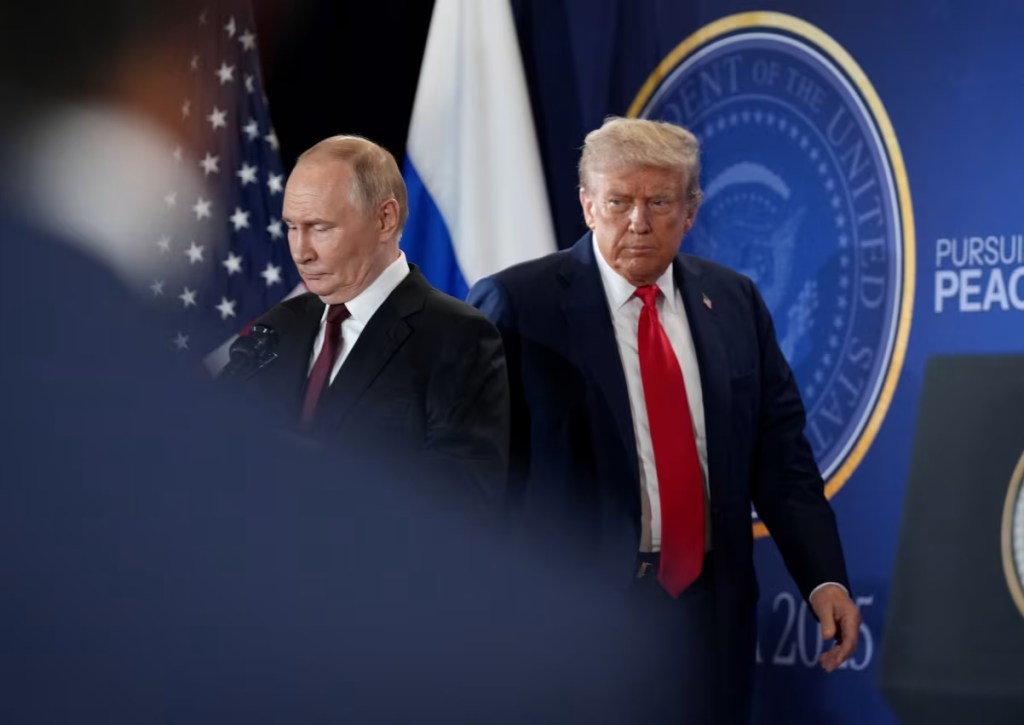
Andrew Harnik/Getty Images/File)
Russia’s harrowing history has bred a dark sense of humor in its citizens.
CIA Director John Ratcliffe’s hosts therefore surely appreciated the irony when he flew into Moscow this week, reportedly to tell the Russians that they are losing their debacle of a war in Ukraine.
Russian spy chiefs might have pointed out that President Donald Trump, like President Vladimir Putin, is also embroiled in a war — in Iran — that he can’t win and can’t end.
Two leaders in two different conflicts face a similar dilemma: They can’t achieve their war ends. But they can’t walk away and save face.
Each launched hostilities after apparently underestimating the tenacity and capacity of adversaries whose militaries were dwarfed by the conventional power and matériel of US and Russian forces.
Both Putin and Trump saw their tactical military advantage undermined by unconventional asymmetrical tactics by Ukraine and Iran that pioneered cheap new technologies like drones and a new era of warfare.
In its report describing Ratcliffe’s visit, the New York Times noted a concern long shared by many in the Washington foreign policy community that Putin is not getting honest assessments of the war’s trajectory. Many observers wonder whether Trump’s sunny assessments of US victory in Iran mean he’s also poorly served by an inner circle unwilling to give him bad news.
Washington and Moscow are no strangers to costly foreign entanglements; both, for example, were humbled by wars in Afghanistan. Russia’s disaster in Ukraine in some way recalls the US defeat in Vietnam.
Souce: CNN
 Voice that counts
Leave a comment